Products


VIEW A SAMPLE OF ITEM
including: Table of Contents, overviews and selected pages.
Sample How to Improve Student Learning

Get Adobe Reader

ADDITIONAL INFORMATION AVAILABLE BELOW

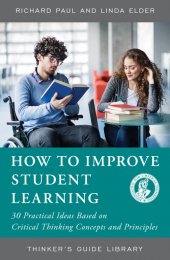
How to Improve Student Learning (For Those Who Teach)

Author: Richard Paul and Linda Elder
Publisher: Foundation for Critical Thinking
Copyright: 2007
Pages: 48
Dimensions: 5 1/4" x 8"
ISBN (10Digit): 0-944583-12-1
ISBN (13Digit): 978-0-944583-12-8


Kindle Version

Provides 30 practical ideas for the improvement of instruction based on Critical Thinking Concepts and Tools. It builds on, and goes beyond, the ideas in the mini-guide Active and Cooperative Learning. It cultivates student learning encouraged in the How to Study and Learn mini-guide.

$6.00


SKU: Title - Item Detail Price Add Items
560M A Miniature Guide For Those Who Teach On How to Improve Student Learning Qty.

Additional Information About:
How to Improve Student Learning (For Those Who Teach)

This guide presents 30 instructional ideas based on the goal of teaching all subjects so that, as a consequence, students take ownership of the most basic principles and concepts of the subject. Most of our suggestions represent possible teaching strategies. They are based on a vision of instruction implied by critical thinking and an analysis of the weaknesses typically found in most traditional didactic lecture/quiz/test formats of instruction. 


Students should master fundamental concepts and principles before they attempt to learn more advanced concepts. If class time is focused on helping students perform well on these foundational activities, we feel confident that the goals of most instruction will be achieved.


Our goal is not to dictate to you, but to provide you with possible strategies with which to experiment. The specific suggestions we recommend represent methods and strategies we have developed and tested with our students. Judge for yourself their plausibility. Test them for their practicality. Those that work (i.e., improve instruction) keep; those that do not work, abandon or re-design.


Contents include:

  • Encourage students to think—quite explicitly—about their thinking
  • Encourage students to think of content as a form of thinking
  • Use engaged lecture
  • Make the point that the content is a SYSTEM of interconnected ideas
  • Discuss the textbook as the thinking of the author
  • Make the course “work-intensive” for the students, but not for you
  • Relate content whenever possible to issues and problems and practical situations in the lives of your students
  • Design instruction so that students engage in routine practice in internalizing and applying the concepts they are learning (and in evaluating their understanding of each)
  • Routinely ask questions that probe student understanding of the content
  • Teach students how to assess their writing
  • Teach students how to assess their listening
  • Teach students how to assess their speaking
  • Teach students how to assess their reading