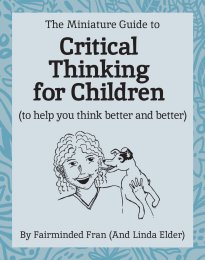
The Miniature Guide to Critical Thinking for Children

Author: Linda Elder


Order from Foundation for Critical Thinking Press:


Order Here
(SKU 005- ELDER-04)


Contact Info for Foundation for Critical Thinking Press:


 Email: orders@criticalthinking.org
Phone:
+1 800 833 3645


An excellent book for children that makes the concepts of critical thinking clear and easy to understand.


Fairminded Fran, Naive Nancy and Selfish Sam teach children about critical thinking – what it is, and why it's important. This book tells children that critical thinkers think about their thinking. They look for problems in their thinking. They practice thinking just like players practice basketball or baseball. This book is an excellent teaching tool for children.

$18.99


SKU: Title - Item Detail Price Add Items
The Miniature Guide to Critical Thinking for Children

Additional Information About:
The Miniature Guide to Critical Thinking for Children

Why A Critical Thinking Mini-Guide For Children?

From a young age, children are capable of learning some of the foundational critical thinking concepts and skills. Though they are largely egocentric, children can nevertheless begin to think about how their behavior affects other people. They can begin to take thinking apart (to focus, for example, on purpose, questions, information, inferences, in thinking). They can begin to apply intellectual standards to their thinking (such as clarity, accuracy, relevance, and logicalness). They can begin to develop intellectual virtues (such as intellectual perseverance, intellectual humility, and intellectual integrity).

The Miniature Guide to Critical Thinking for Children introduces children to some of the most basic concepts in critical thinking, making these concepts accessible to them through simplified language.

The simplest way to use the guide is to foster student questioning using the model questions throughout the guide. If teachers routinely ask these questions of their children and regularly encourage children to ask these questions of their classmates, they will be pleased with the results. Thinking is question-driven. When children have no questions, they have no motivation to learn, to inquire, to discover. When teachers regularly focus on the questions in The Miniature Guide to Critical Thinking for Children, students learn to formulate questions that improve their learning.

Teachers who use the guide may also be interested in obtaining its accompanying The Teacher's Manual to the Children's Guide to Critical Thinking. The manual provides suggestions for using The Miniature Guide to Critical Thinking for Children and for teaching basic critical thinking concepts. It also contains "Think for Yourself" activities for children to help them internalize critical thinking ideas. Another companion publication is Think About Fran and Sam: Which is Better at Their Thinking?


Announcing the Return of the
Foundation for Critical Thinking Press

The Foundation for Critical Thinking has reopened its publishing house at FCTPress.Org. Several publications are available now, including the award-winning Critical Thinking Therapy: For Happiness and Self-Actualization, with more to come.

The FCT Press also offers self-publishing services for authors.